Why Fire Suppression Systems Use Thinner Pipe Than You Might Expect
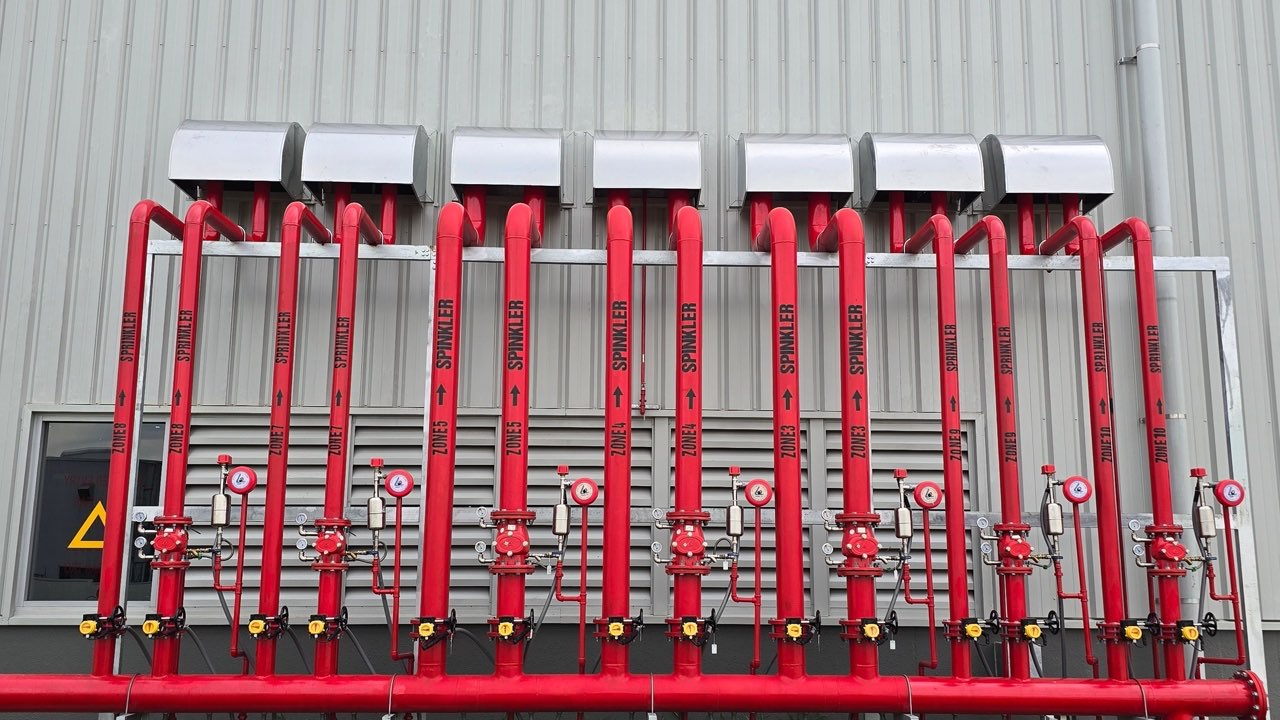
If you’ve ever looked at the piping specifications for a commercial fire sprinkler system and noticed that Schedule 20 appears alongside Schedule 40 — with Schedule 20 being used for the larger-diameter mains — you might wonder whether that’s a cost-cutting measure or whether it’s actually correct. The short answer is that it’s correct, and understanding why tells you something useful about how pipe schedules work in practice.
Pressure Is the Variable, Not Size
The default assumption many people bring to pipe selection is that thicker walls are always safer. This is true up to a point, but it misses the fact that pipe specifications are pressure ratings, not safety ratings in the absolute sense. A given pipe is specified correctly when its wall thickness is sufficient for the operating pressure of the system — not when it’s as thick as possible.
Fire sprinkler systems typically operate in a pressure range of 40 to 175 psi, with the majority of wet-pipe commercial systems running at the lower end of that range. The working pressure that a Schedule 20 pipe can handle in large diameters — NPS 8 through NPS 24 — is well within this range when the pipe meets ASTM A53 Grade B or equivalent specifications. The thinner wall isn’t a compromise; it’s correctly matched to the application.
Schedule 40 for large-diameter pipe exists for applications that actually require the additional wall thickness: higher-pressure systems, elevated-temperature service, or installations where the pipe is subject to external loads or corrosive environments. In a standard wet-pipe fire suppression system, those conditions don’t apply to the mains. Specifying Schedule 40 where Schedule 20 is sufficient adds cost and weight without adding meaningful safety margin for that specific use case.
Why This Matters More in Large Diameters
Schedule 20 doesn’t exist for small pipe sizes — ASME B36.10M defines Schedule 20 dimensions starting at NPS 8. This isn’t arbitrary. At smaller diameters, the wall thicknesses available in standard schedules are already relatively thin compared to the pipe diameter, and the weight difference between schedules is modest. At large diameters, the difference becomes substantial.
An NPS 12 pipe in Schedule 40 has a wall thickness of 10.31 mm and weighs roughly 73 kg per meter. The same pipe in Schedule 20 has a 6.35 mm wall and weighs around 50 kg per meter. That’s a 30 percent weight reduction per linear meter. In a large commercial or industrial facility where the fire suppression main runs hundreds of meters through the building and needs to be supported from the structure above, this reduction in dead load has real engineering implications — it affects the hanger spacing, the structural support requirements, and the total cost of installation.
The weight reduction is not just a cost factor. In seismic zones, lighter pipe with appropriate fittings and seismic bracing can actually perform better than heavier pipe with inadequate support, because the system has less mass to generate inertial loads during ground motion.
What the Standards Actually Require
NFPA 13, which governs the installation of sprinkler systems in the United States, permits Schedule 20 pipe for specific applications and sizes. It’s not simply accepted as an informal industry practice — it’s an explicitly listed option in the standard, with requirements around pipe material grade, joining method, and system type.
For wet-pipe and dry-pipe systems, Schedule 20 is permitted for use as mains in sizes NPS 8 and larger. Smaller branch lines and sprigs are typically Schedule 40 or lightweight alternatives qualified under NFPA 13 listing criteria. The mains, which carry water from the riser to the branch line zones, are the large-diameter sections where Schedule 20 is most commonly applied.
The material must meet ASTM A795 (carbon steel pipe for fire protection service) or the equivalent. A795 pipe is available in both Schedule 10 and Schedule 40, and Schedule 20 steel pipe meeting A53 or A135 may also be acceptable depending on the authority having jurisdiction and the specific listing of the system components. The installer’s responsibility is to specify and document the pipe grade, not just the schedule number.
The Practical Outcome
In a typical mid-size warehouse or distribution center with a ceiling height of 9 to 12 meters and a floor area of several thousand square meters, the fire suppression main might run 200 to 400 meters in aggregate across all zones. At those lengths, the choice between Schedule 20 and Schedule 40 for the mains affects both the material cost and the labor cost of installation, since lighter pipe is easier to handle and requires less structural support.
None of this means that Schedule 40 is wrong for fire suppression mains — it’s just often more than the system requires. The correct specification is the one that meets the pressure rating, material grade, and code requirements for the application. For most commercial wet-pipe systems with large-diameter mains, Schedule 20 meets all of those requirements with margin to spare.